
Understanding Opal Jewelry: Why This Misunderstood Gemstone Deserves a Second Look

Opals carry a complex reputation. People love their beauty—those magical flashes of color that seem to dance across the stone’s surface. But they also worry: Are opals too fragile? Will they crack? Are they a serious investment, or simply a pretty novelty?
The truth is more nuanced. Opals are genuinely unique gemstones with properties unlike any other stone. They require thoughtful care, but they are not nearly as fragile as their reputation suggests. A quality opal—especially a fine black opal from Australia—can be as valuable and meaningful as any precious gemstone.
It is time to reclaim opal’s reputation. Here is what makes opals special, how to care for them, and why an opal piece may be exactly the distinctive jewelry you have been looking for.
What Makes an Opal an Opal?
Opal is not a crystal like diamond, ruby, or sapphire. It is an amorphous gemstone, meaning it has no ordered crystal structure. Instead, opal consists of tiny spheres of silica gel arranged in a random pattern, with water trapped between them. This distinctive structure creates opal’s defining characteristic: play-of-color.
When light enters an opal, it is diffracted by the tiny silica spheres. Different wavelengths of light bounce and refract at different angles, producing the familiar flashes of red, green, blue, and other hues. No two opals display the same pattern of color, which makes each stone entirely individual.
This structure also explains why opals differ from other gemstones. Opals typically contain 3–20% water, which makes them more sensitive to extreme temperature changes and very dry environments. Understanding that sensitivity is central to caring for opal jewelry well.
Most opals on the market come from Australia, which produces approximately 95% of the world’s precious opals. The most valuable opals come from specific Australian deposits, particularly Coober Pedy and Lightning Ridge, which produce the legendary black opals.
The Different Types of Opals

Not all opals are created equal. Understanding the categories helps you evaluate what you are seeing and better understand the range in pricing.
Precious Opals
Precious opals display significant play-of-color: the brilliant flashes of red, green, blue, and other hues associated with fine opal jewelry. They are the valuable type, suitable for fine jewelry and collecting. Within this category, there are several important subtypes.
Black Opals
Black opals are the rarest and most valuable. They have a dark body color—black, dark gray, or dark brown—with vibrant play-of-color against that dark background. The contrast makes the colors appear to glow. Black opals from Lightning Ridge are considered among the finest in the world and can command extraordinary prices.
White Opals
White opals have a light body color—white, cream, or pale gray—with play-of-color. They are more common and more accessible than black opals, while remaining valuable and beautiful in their own right.
Crystal Opals
Crystal opals are transparent to translucent, with play-of-color visible throughout the stone. They are rarer and generally more valuable than white opals, offering a particularly luminous aesthetic.
Common Opals
Common opals, sometimes called potch, display little to no play-of-color. They are opaque, often brown or red, and are used primarily in decorative applications rather than fine jewelry. They are less expensive, but lack the distinctive appearance and value of precious opals.
Fire Opals
Fire opals, primarily from Mexico, have a warm red, orange, or yellow body color with little to no play-of-color. They are transparent to translucent and offer a different look from precious opals. Fire opals are valued for their body color rather than the flash of color associated with black, white, and crystal opals.
Evaluating Opal Quality

When evaluating opal jewelry, several factors determine value, desirability, and long-term appeal.
Color Brilliance and Pattern
The most valuable opals display brilliant colors—especially vivid reds, greens, and blues that seem to glow. The pattern matters, too. Broad flashes of color are generally more valuable than tiny, scattered dots. Some collectors prefer particular patterns or color combinations, which can affect desirability and price.
Body Tone
For precious opals, a darker body tone, as seen in black opals, is more valuable because it creates contrast with the play-of-color. Lighter body tones, as in white opals, are usually less expensive but can still be exceptional.
Clarity and Transparency
Fine precious opals should be clear and transparent, or at least translucent. Cloudy or muddy stones are less valuable. Crystal opals, which are transparent, are generally more valuable than white opals.
Cut and Cabochon Quality
Opals are typically cut as cabochons—smooth, domed stones—rather than faceted. The cabochon should be symmetrical, properly proportioned, and cut to showcase the play-of-color at its best.
Durability and Treatment
This is where opal’s reputation comes in. Opals rank 5.5 to 6.5 on the Mohs hardness scale, softer than most gemstones used in jewelry. This does not mean they are impractical; it means they benefit from deliberate care.
Many opals are treated to improve durability and appearance. Some are oiled or waxed to fill surface cracks and enhance color. Others are stabilized or backed with a harder material. These treatments are standard and accepted, but they can affect value. Always ask about treatment before making a purchase.
Opals as Jewelry: The Care Question

Yes, opals require more care than diamonds or sapphires. But requiring care does not mean they are impractical for jewelry. It means you need to be intentional.
How to Care for Opal Jewelry Properly
• Remove opal jewelry before swimming, showering, or washing dishes.
• Avoid exposing opals to extreme temperature changes.
• Do not store opals in very dry environments. Use a sealed container with a slightly damp cloth to help maintain moisture.
• Clean opals gently with lukewarm water and mild soap.
• Avoid ultrasonic and steam cleaners.
• Protect opals from hard impacts and pressure.
• Have opal settings checked periodically for security.
With these precautions, an opal piece can last a lifetime. Many antique opal pieces, carefully preserved, are still stunning centuries later.
Opals as Engagement Rings
Opal engagement rings are unconventional, and that is their appeal. If you want something distinctive, meaningful, and completely one-of-a-kind, an opal engagement ring makes a powerful statement.
The consideration is that opals require more careful handling than traditional engagement-ring stones. If you are hard on your jewelry or work with your hands frequently, an opal may not be the best choice. But if you are willing to treat it thoughtfully and love its distinctive beauty, an opal ring can be extraordinary.
Consider pairing opal with a protective setting, perhaps surrounded by diamonds, to help minimize the risk of impact damage.
Opals as Investment and Heirloom Pieces
Fine black opals can appreciate over time, especially Australian opals with documented provenance. However, opal investment is more speculative than investment in rubies or emeralds, and the secondary market for opals is smaller and less predictable.
Where opals truly excel is as heirloom pieces. An opal necklace or ring becomes more meaningful with time and care. The story of the piece—where it came from, who wore it, and how it was treasured—becomes part of its value. An opal’s uniqueness makes it especially suited to this role.
Finding Your Opal
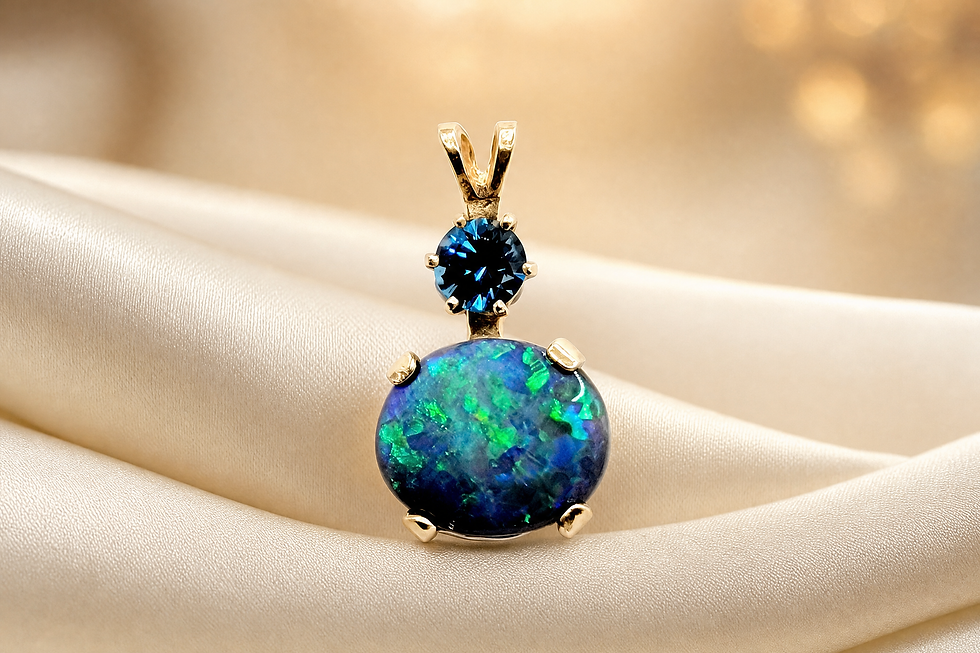
Whether you are drawn to opals for their distinctive beauty, their uniqueness, or their rarity, approach the purchase thoughtfully. Buy from a reputable jeweler who understands opals. Ask about treatment, origin, and durability. Choose a piece you will love and care for properly.
At Robert Michael Gems, we work with clients seeking distinctive, meaningful jewelry that stands apart from conventional choices. We source high-quality opals and create custom pieces that honor the gemstone’s unique beauty and character. Whether you are seeking an opal pendant, an unconventional engagement ring, or a piece to become a family heirloom, we can guide you through the process with expertise and genuine care.
Gem Spotlight: Garnet

Garnet is often relegated to birthstone status, but it deserves far more respect. It is not a single gemstone; it is a family of minerals that includes many varieties.
Most people think of deep red garnet, but garnets come in almost every color: orange spessartine garnet, green tsavorite garnet, pink rhodolite garnet, and even colorless varieties.
What makes garnet special is its versatility and availability in large sizes at reasonable prices. A five-carat rhodolite garnet can cost far less than a five-carat ruby, yet display similar beauty. Tsavorite garnets rival emeralds in green color, and garnets rank 7–7.5 on the Mohs hardness scale, making them suitable for many types of jewelry.
Garnets have been treasured for thousands of years. They were worn by ancient Egyptians and Roman soldiers, and they appear in historical texts and religious writings. For collectors and people seeking alternative gemstones with history and beauty, garnet offers surprising depth and value.
With genuine appreciation for your vision, **Robert Michael Gems**


Comments