
Vintage Gemstone Jewelry: How to Evaluate, Restore, and Fall in Love with a Piece of the Past
There's something magical about vintage gemstone jewelry. It carries history. It tells a story. And if you know what to look for, it can be a remarkable value—and a genuine investment—in ways that new jewelry often isn't.
But vintage jewelry also comes with questions. How do you know if what you're buying is authentic? What's the difference between vintage and antique? How do you care for a piece that's been passed down through decades (or centuries)? And when does a vintage find need professional restoration?
Let's talk about how to approach vintage gemstone jewelry with confidence.

What Actually Counts as Vintage Gemstone Jewelry?
First, let's clarify the terminology, because it matters when you're shopping and evaluating pieces.
Vintage jewelry is generally considered to be between 20 and 100 years old. This typically includes Art Deco pieces (1920s-1930s), mid-century modern designs (1940s-1960s), and retro or bohemian pieces from the 1970s and 1980s. Anything older than 100 years is classified as antique. Anything newer than 20 years is considered contemporary or modern.
Why does this matter? Age affects value, rarity, and how you should care for the piece. A 1920s Art Deco diamond ring with an original setting carries different considerations than a 1970s sapphire pendant. Understanding the era helps you understand what you're looking at.
Why Vintage Gemstone Jewelry Is Worth Your Attention
There are several compelling reasons to consider vintage pieces:
Craftsmanship and Design
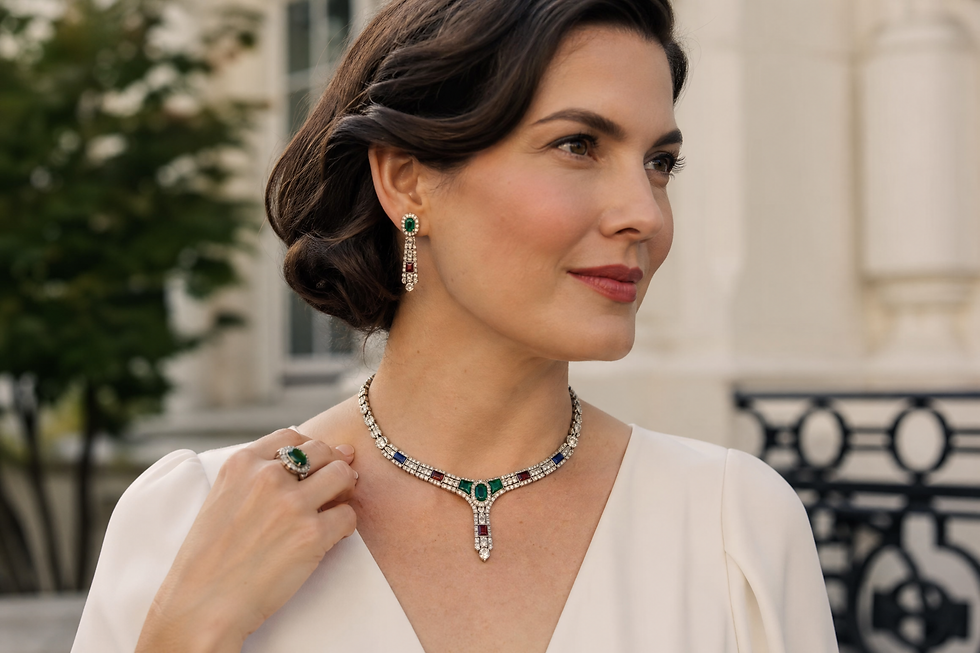
Vintage jewelry, especially from the Art Deco and mid-century modern eras, was often handcrafted by skilled artisans. The attention to detail, the precision of the settings, and the design sophistication can surpass mass-produced contemporary pieces. These weren't made on assembly lines; they were made by jewelers who understood their craft deeply.
Rare Gemstones and Cuts
Vintage jewelry often features gemstones and cutting styles that are no longer common. You might find a stunning Old European cut diamond (which creates a different sparkle than modern brilliant cuts), or a natural, untreated ruby or sapphire from an era before widespread gemstone treatment. These rarity factors can actually increase value and desirability.
Ethical and Environmental Considerations
When you buy vintage, you're choosing a stone that's already been mined and refined. You're not contributing to new mining operations or environmental impact. For people concerned about the ethics of gemstone sourcing, vintage jewelry is an inherently sustainable choice.
Value and Investment Potential
High-quality vintage gemstone jewelry, especially pieces with documented provenance, can hold value better than new jewelry and may appreciate over time. You're not paying the retail markup that applies to new pieces. You're buying based on the actual intrinsic value of the materials and the craftsmanship.
How to Evaluate Vintage Gemstone Jewelry (And Know You're Making a Smart Choice)
Not all vintage jewelry is created equal. Here's how to assess a piece:

Check the Metals and Settings
Examine the metal—is it gold, platinum, silver, or an alloy? Look for hallmarks (stamps indicating purity, like 14K, 585, or .925). Vintage pieces should have clear markings. If a piece claims to be vintage gold but has no hallmark, that's a red flag.
The setting itself tells you a lot. Is it sturdy? Are the prongs or bezels holding the stone securely? Does the metalwork show signs of careful craftsmanship or sloppy production? Run your finger along the edges. Well-made vintage pieces have smooth, finished edges.
Assess the Gemstones
This is where expertise matters most. If you're buying vintage jewelry as an investment or with significant money involved, get an independent gemological appraisal. A qualified gemologist can identify:
- The actual type of gemstone (sometimes vintage pieces are mislabeled)
- Whether the stone is natural or treated
- The quality, clarity, and color grade
- Any damage or repairs
- Estimated age and origin (when possible)
For vintage colored stones especially, this is crucial. A natural, untreated ruby from Burma is fundamentally different from a heat-treated ruby, and that difference affects both value and longevity.
Look for Signs of Wear and Repair
Vintage jewelry will show signs of age—that's part of its charm and authenticity. But you need to distinguish between acceptable patina and problematic damage. A gentle scratch on the band is normal. A crack in the gemstone is a serious concern. Solder marks or obvious repairs might indicate previous damage that was fixed; ask about this.
Know the Provenance
Can you trace the piece's history? Does it come with documentation, a receipt, or a family story? Provenance adds significant value to vintage jewelry. A piece with a known history—"This was my grandmother's engagement ring from 1952"—is worth more than an identical piece with no story. If you're buying from a dealer, ask for documentation and guarantees.
Common Vintage Eras and What to Know About Them
Art Deco (1920s-1930s)

Art Deco jewelry is highly collectible. Expect geometric designs, often with diamonds and colored stones set in platinum or white gold. These pieces are typically extremely well-made and can be quite valuable. Prices reflect this.
Mid-Century Modern (1940s-1960s)
This era produced some stunning designs, often featuring larger colored stones and more colorful, artistic settings. The metalwork is typically excellent. Many mid-century pieces are still reasonably priced because they're less "trendy" than Art Deco, but the quality is equally high.
Retro and Bohemian (1970s-1980s)
These pieces often feature bold colors, interesting cuts, and more experimental designs. They're currently having a renaissance in popularity. Quality varies more widely than in earlier eras, so careful evaluation is essential.
When Vintage Jewelry Needs Professional Restoration
Sometimes a vintage piece needs more than just cleaning. Here's when professional restoration makes sense:
- Loose or missing stones
- Bent or damaged prongs
- Worn settings that no longer hold the stone securely
- Desired changes (like resizing, redesigning, or re-setting a stone in a new mount)
- Deep cleaning that requires professional equipment
A good jeweler can restore a vintage piece while preserving its integrity and historical value. This is worth investing in if you love the piece and plan to wear it or pass it down.
Making Vintage Gemstone Jewelry Part of Your Collection
The beauty of vintage jewelry is that it allows you to own something with history, character, and genuine craftsmanship—often at a price point that's more accessible than new luxury pieces of comparable quality.
Whether you're drawn to vintage for investment reasons, ethical considerations, or simply because you love the design and story, approach it thoughtfully. Get professional guidance when you need it. Ask questions. Understand what you're buying. And choose pieces that make you happy—because that's where the real value lies.
At Robert Michael Gems, we work with people who appreciate the artistry and heritage of fine gemstone jewelry, whether it's vintage, contemporary, or newly handcrafted. If you're considering a vintage piece and want guidance on authenticity, restoration, or value, we're here to help. We can also work with you to restore a vintage family heirloom or reimagine a vintage stone in a new design that honors its past while fitting your life today.

Gem Spotlight: Alexandrite
Let's talk about alexandrite—a gemstone that was far more common in vintage jewelry than it is today, and one that deserves far more attention.

Alexandrite is a variety of chrysoberyl that exhibits one of nature's most extraordinary properties: color-changing ability. In daylight, alexandrite appears green or blue-green. Under incandescent light, it shifts to red or pink. This dramatic transformation captured the imagination of Victorian and early 20th-century jewelers, and alexandrite became especially popular in vintage pieces from that era.
What makes alexandrite special for vintage collectors is that it's genuinely rare and valuable. Fine-quality alexandrite is rarer than diamonds. It ranks 8.5 on the Mohs hardness scale, making it durable for any jewelry. And because it was more fashionable in earlier eras, you're more likely to find stunning vintage pieces featuring it—often at prices that don't yet reflect its rarity and desirability.
Alexandrite is having a quiet renaissance among people who appreciate gemstones deeply. If you're hunting vintage jewelry or building a collection, a piece of fine alexandrite is a treasure that will only become rarer and more valuable over time.
---
With genuine appreciation for your vision,
Robert Michael Gems


Comments