
How to Clean Gemstone Jewelry at Home (Without Accidentally Ruining It)
There's a question that comes up at some point for nearly every jewelry owner, and it usually arrives the moment a beloved ring catches the light at the wrong angle and looks… not quite like it used to. How do you clean gemstone jewelry properly? Not just a quick rinse under the tap, but a real clean that restores the brilliance you fell in love with — without risking the stone, the setting, or the finish of the metal? The answer is more nuanced than most advice on the internet suggests, and it depends almost entirely on what the stone actually is.

Why "One Method Fits All" Is a Myth
The most common jewelry cleaning advice you'll find online — "soak in warm soapy water and scrub with a soft toothbrush" — is solid guidance for some gemstones. For others, it ranges from suboptimal to genuinely damaging. The difference comes down to how each stone interacts with water, heat, cleaning agents, and mechanical agitation. A diamond is nearly indestructible. An opal is not. An emerald has usually been treated with oils or resins that common cleaning methods will strip out. A porous coral or turquoise will absorb whatever liquid you put it in.
Before you clean any piece of gemstone jewelry, you need to know two things: what the stone is, and whether it has been treated. If you're not certain, don't guess — ask your jeweler. The cleaning conversation is exactly the kind of thing a good jeweler should be happy to have with you, because the cost of the wrong method can be far higher than the cost of asking.
How to Clean Gemstone Jewelry: A Stone-by-Stone Guide
Hard, Untreated Stones: The Forgiving Category
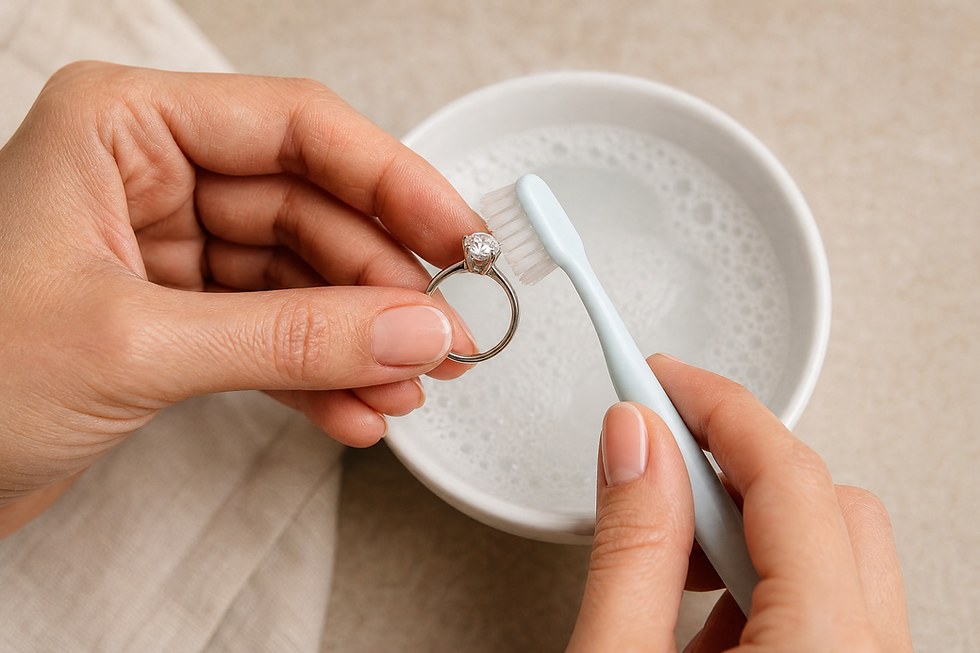
Diamonds, rubies, and sapphires sit at the top of the Mohs hardness scale and are the most forgiving stones to clean at home. All three are corundum or carbon-based, chemically stable, and don't absorb liquids. For these stones, the warm soapy water method works well: a bowl of warm (not hot) water with a few drops of mild dish soap, a brief soak of five to ten minutes, and a gentle scrub with a soft-bristle brush — a baby toothbrush is ideal — around the setting and under the stone where grease and skin oils accumulate. Rinse thoroughly and let air dry on a clean cloth or pat dry gently.
The key word in all of this is gentle. You're not scrubbing a pan. You're dislodging the thin film of lotions, oils, and everyday residue that dulls the stone's surface. That film is removed with light pressure and patience, not force. And rinse more than you think you need to — soap residue left in a prong setting can create its own film that's just as dulling as the grime you removed.
Emeralds: The Exception You Need to Know About

Emeralds require a separate conversation. Nearly all emeralds on the market — the vast majority, including stones from reputable dealers — are treated with oil or resin to fill surface-reaching fractures and improve apparent clarity. This is an industry standard and isn't inherently deceptive; it's disclosed by any responsible seller and appears on lab reports. But it has a direct implication for cleaning: ultrasonic cleaners and steam cleaners will strip the oil from an emerald's fractures, leaving the stone looking significantly worse than before you started.
For emeralds, the correct method is a lightly dampened soft cloth, wiped gently across the surface. No soaking. No ultrasonic. No steam. No harsh cleaning agents. If your emerald needs a deeper clean, take it to a jeweler who can re-oil the stone professionally afterward. This is also why emeralds should not be worn while swimming, bathing, or using skincare products — the cumulative exposure to liquids and chemicals degrades the treatment over time.
Pearls, Opals, and Porous Stones: Handle with Care

Pearls, opals, turquoise, coral, malachite, and moonstone all fall into the category of stones that require the most careful handling when it comes to cleaning. Pearls are organic — formed by living creatures — and their lustrous nacre surface is sensitive to acids, perfumes, hairsprays, and even perspiration. The classic advice is correct: put your pearls on last when getting dressed, and take them off first. To clean them, wipe with a barely damp soft cloth after each wear and allow them to air dry completely before storing. Never submerge pearls in water or use any cleaning solution stronger than plain water on a cloth.
Opals are equally sensitive.
They contain water as part of their structure — typically five to ten percent by weight — and sudden temperature changes or prolonged exposure to drying environments can cause crazing (a network of surface cracks that permanently damages the play of color). Warm soapy water in brief contact is generally safe for natural opals, but soaking is not. Avoid ultrasonic cleaners entirely. Doublet and triplet opals, which have thin opal layers bonded to backing material, are even more sensitive and should only be wiped clean — water can penetrate the seam and cause delamination.
Turquoise and coral are porous and will absorb whatever liquid contacts them, including the oils from your skin. Over time, this can alter the stone's color. Clean these stones only with a dry or barely damp soft cloth, and keep them away from all cleaning products, perfumes, and lotions.
What to Know About Ultrasonic and Steam Cleaners
Ultrasonic cleaners — the machines that clean jewelry using high-frequency sound waves — are genuinely effective for appropriate stones and can restore brilliance that hand-cleaning won't fully achieve. They work by creating microscopic cavitation bubbles in the liquid that knock loose debris from every surface, including the back of the stone and beneath prongs.
The stones that are safe for ultrasonic cleaning include diamonds (with one caveat: diamonds with significant fractures or feather inclusions may be at risk from the vibration), rubies, and sapphires. Many other stones are not safe: emeralds, opals, tanzanite, pearls, turquoise, coral, and any stone with known fractures or heavy inclusions. When in doubt, ask — or skip the ultrasonic and hand-clean instead. The rule of thumb is that if the stone has any sensitivity to heat, temperature change, or liquid absorption, it does not go in the ultrasonic.
Steam cleaners carry similar risks and should be used by professionals rather than at home unless you're working exclusively with hard, untreated stones in well-secured settings.
How Often Should You Clean Gemstone Jewelry?
The honest answer is: it depends on how often you wear it. A ring worn daily will collect a film of lotions, soaps, and natural skin oils within a week or two — sometimes faster. A pendant worn occasionally might go a month between cleanings without looking noticeably dull. The practical approach is to clean frequently-worn pieces every two to four weeks with a gentle home method, and bring them in to a jeweler for a professional inspection and deeper clean once or twice a year.
That yearly professional clean is worth treating as a maintenance appointment, not just a cosmetic service. A jeweler inspecting your piece will check prong integrity, look for any loosening in the setting, and identify wear patterns before they become problems. A prong that's worn thin is a risk to the stone. Catching it early is always less expensive — and less heartbreaking — than dealing with it after a stone is lost.
Storage Is Half the Battle
How you store jewelry between wearings matters as much as how you clean it. The most common mistake is keeping multiple pieces together — in a dish, a jewelry box without dividers, or a travel pouch — where harder stones scratch softer ones. Diamond earrings resting against an amethyst ring will scratch it. Pearls stored against metal clasps develop surface abrasion over time.
Store pieces individually in soft pouches or fabric-lined compartments. Keep pearl strands laid flat — hanging them causes the silk thread to stretch and weaken over time. Store opals in slightly humid conditions (never airtight containers in dry climates, which can contribute to dehydration crazing). And keep jewelry away from direct sunlight, which can fade certain colored stones over time, including amethyst and kunzite.
Cleaning Gemstone Jewelry You Didn't Buy Yourself
Inherited pieces, estate jewelry, and gifts present a specific challenge: you may not know what you're working with. Before you clean anything with an unknown history, take it to a jeweler for identification.

The stone type, treatment status, and setting integrity all affect which cleaning methods are appropriate. A beautiful vintage ring with an unusual stone is not the moment to experiment with a cleaning method you found in a blog post. It's the moment to ask someone who knows exactly what they're looking at.
At Robert Michael Gems, part of what we do is help buyers understand the pieces they already own — not just the ones they're shopping for. If you've inherited a piece and aren't sure what you have, or you want a thorough inspection and professional clean before you start wearing something regularly, that conversation is always welcome. Knowing what you own is the foundation of caring for it well.
Gem Spotlight
Chrysoberyl Cat's Eye

Most people who encounter a chrysoberyl cat's eye for the first time react the same way: they tilt it, hold it under a single light source, watch the bright band of light move across the surface like the slit pupil of a living eye — and then immediately want to know what they're looking at. This phenomenon, called chatoyancy (from the French oeil de chat, "eye of the cat"), occurs when light reflects off densely packed, parallel needle-like inclusions within the stone, creating a single luminous line that moves as the stone turns. It's one of the most striking optical effects in the gem world.
Chrysoberyl cat's eye is different from the more commonly known "tiger's eye," which is a quartz variety. True cat's eye — when you see the term unmodified by a species name — refers to chrysoberyl cat's eye, and it's in a different league entirely. The best examples come from Sri Lanka and Brazil and range in color from honey yellow to a golden green, with the most prized specimens showing a milk-and-honey effect: a bright cat's eye against a body color that appears distinctly two-toned when the stone is rotated.
Chrysoberyl scores an 8.5 on the Mohs scale, making it exceptionally durable and genuinely suitable for everyday wear — all the drama of the cat's eye with the hardness to back it up. If you've never held a fine chrysoberyl cat's eye under a single point-source light and watched it perform, put it on the list. It's the kind of moment that permanently expands what you thought gemstones could do.
The Bottom Line on How to Clean Gemstone Jewelry
The fundamentals are straightforward: know your stone, know whether it's been treated, and match your cleaning method to those facts. Most hard, untreated stones respond beautifully to warm soapy water and a soft brush. Treated, porous, or structurally sensitive stones require gentler approaches and more careful handling. Ultrasonic cleaners are powerful tools for the right stones and risks for the wrong ones. And a professional clean and inspection once or twice a year is the most useful maintenance habit a jewelry owner can develop.
The most expensive cleaning mistake is the one made confidently and incorrectly. The easiest way to avoid it is to ask someone who knows — before you clean, not after.
Robert Michael Gems — Specializing in Colorado Gemstones®


Comments